Saturday, May 17, 2008

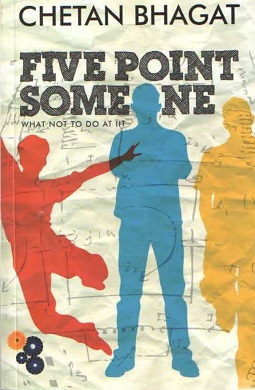
Five point Someone- What not to do at IIT by Chetan Bhagat


Five Point Someone - What not to do at IIT! is the first (2004) novel written by Chetan Bhagat, an alumnus of Indian Institute of Technology (IIT) Delhi and Indian Institute of Management (IIM) Ahmedabad. It is one of the highest selling English novels published in India, and has remained on the bestseller list until 2007 since its release in 2004. It was adapted into a play by the theatre group Madras Players, and soon going to be converted into a Bollywood movie which will be made under Aamir khan's production house.

The novel is set in the Indian Institute of Technology, Delhi, in the period 1991 to 1995. It is about the adventures of three mechanical engineering students (and friends), Hari Kumar (the narrator), Ryan Oberoi, and Alok Gupta, who fail to cope with the cruel grading system of the IITs and come to be known as five pointers due to their perennially low 5.something GPA's.

The book is narrated in the first person by Hari, with some small passages by his friends Ryan and Alok, as well as a letter by Hari's girlfriend Neha Cherian. It deals with the lives of the three friends whose elation on making it to one of the best engineering colleges in India is quickly deflated by the rigor and monotony of academic work. Most of the book deals with the numerous attempts by the trio to cope with and/or beat the system as well as Hari's fling with Neha who just happens to be the daughter of Prof. Cherian, the sadistic head of the Mechanical Engineering Department.

While the tone of the novel is humorous, it takes some dark turns every now and then, especially when it comes to the families of the main characters. Most of the action, however, takes place inside the campus as the boys, led by the ever creative Ryan, frequently lament how the internationally lauded IIT system has stifled their creativity by forcing them to value grades more than anything else. Uninspiring teaching and numerous assignments adds to their woes although the boys do find a sympathizer in Prof. Veera, the new fluid mechanics professor.

Motorcycle Diaries by Ernesto Guevara


The Motorcycle Diaries, originally marketed by Verso as "Das Kapital meets Easy Rider" traces the early travels of Ernesto 'Che' Guevara, then a 23-year-old medical student, and his friend Alberto Granado, a 29-year-old biochemist. Guevara travelled 8,000 miles across South America on an old motorcyle. During the journey he is transformed by witnessing the social injustices of exploited mine workers, persecuted communists, ostracized lepers, and the tattered descendants of a once-great Incan civilization. The book ends with a declaration by Guevara, originally born into an upper middle class family, displaying his willingness to fight and die for the cause of the poor, and his dream of seeing a united Latin America. It has been a New York Times bestseller several times

Wednesday, May 14, 2008

Pluto No more a planet


"Whoa! Pluto's dead," said astronomer Mike Brown, of the California Institute of Technology in Pasadena, as he watched a Webcast of the vote. "There are finally, officially, eight planets in the solar system."

In a move that's already generating controversy and will force textbooks to be rewritten, Pluto will now be dubbed a dwarf planet.

But it's no longer part of an exclusive club, since there are more than 40 of these dwarfs, including the large asteroid Ceres and 2003 UB313, nicknamed Xena—a distant object slightly larger than Pluto discovered by Brown last year.

"We know of 44" dwarf planets so far, Brown said. "We will find hundreds. It's a very huge category."

A clear majority of researchers voted for the new definition at a meeting of the International Astronomical Union (IAU) in Prague, in the Czech Republic. The IAU decides the official names of all celestial bodies.

The tough decision comes after a multiyear search for a scientific definition of the word "planet." The term never had an official meaning before.

What Is a Planet Today?

According to the new definition, a full-fledged planet is an object that orbits the sun and is large enough to have become round due to the force of its own gravity. In addition, a planet has to dominate the neighborhood around its orbit.

Pluto has been demoted because it does not dominate its neighborhood. Charon, its large "moon," is only about half the size of Pluto, while all the true planets are far larger than their moons.

In addition, bodies that dominate their neighborhoods, "sweep up" asteroids, comets, and other debris, clearing a path along their orbits. By contrast, Pluto's orbit is somewhat untidy.